Geothermal Modelling Schlattingen

Rouven Künze, 25. März 2026

Update of the 3D hydrothermal model to simulate heat production from deep groundwater aquifers.
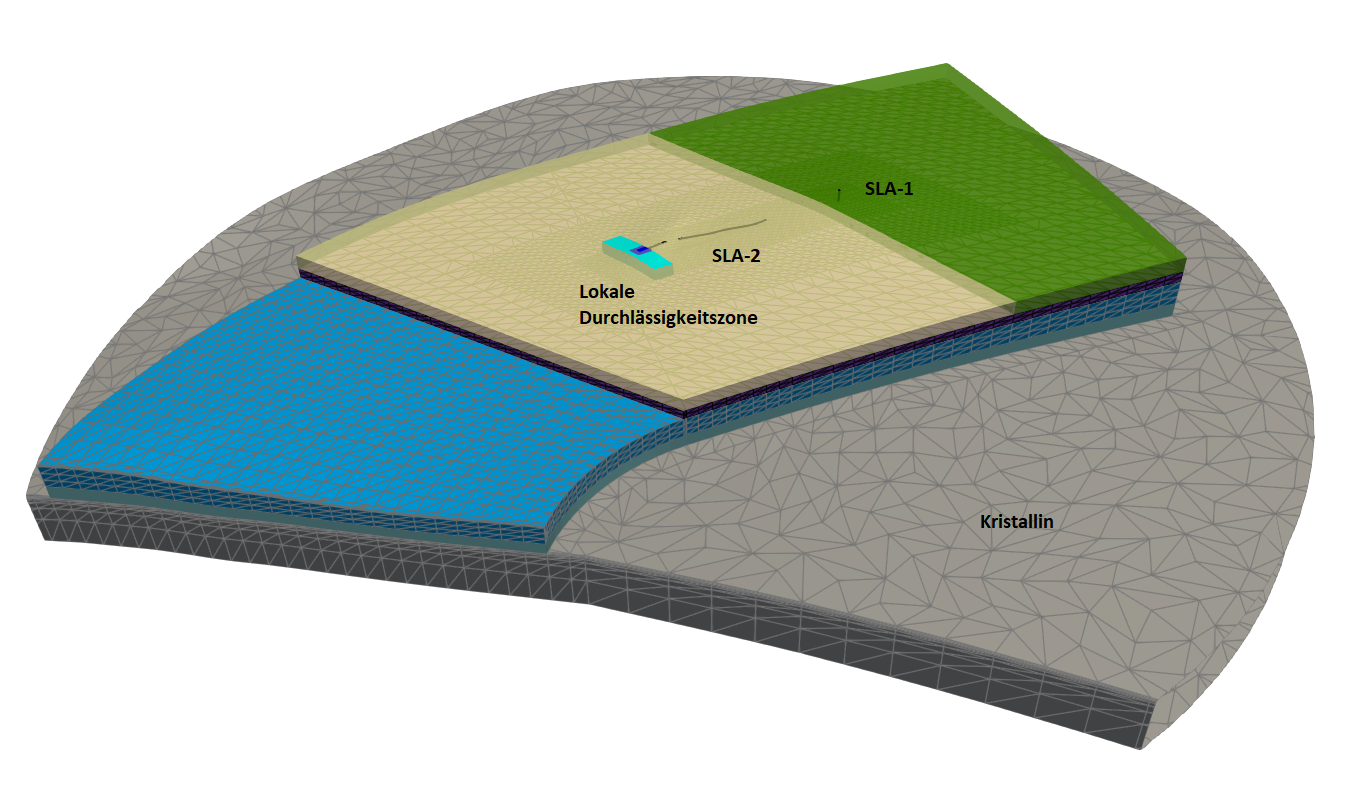
At the beginning of the last decade, Grob Gemüse AG decided to use geothermal energy to meet its long-term heating needs. For this purpose, two boreholes (SLA-1 and SLA-2) were drilled in 2011 and 2013. Since the beginning of the project, TK CONSULT AG has been providing numerical modelling support (Newsletter September 2020). The 3D hydrothermal model extends about 35 km southeast from the Muschelkalk outcrops in the Wutach Valley. In particular, the calibration in 2020 indicated that the SLA-2 borehole is located within a complex geological structure. In the simulation process supporting the licence application, this structure is represented in the numerical model as a low permeability shell.

Following the successful granting of the licence, the two boreholes were used for long-term heating production. The pressure decline and water yield of both wells were recorded. Furthermore, as part of a research project funded by the Swiss Federal Office of Energy (BFE), further hydrochemical and isotopic analyses of the water samples were carried out by Hydroisotop (Schweitenkirchen, Germany). The analysis revealed that chemically isolated compartments exist within the Muschelkalk aquifer in Schlattingen. Subsequently, the University of Bern (Institute of Geology) adapted and further developed the 2020 conceptual model by incorporating reactive transport modelling.

The Thurgau Energy office commissioned TK CONSULT AG, the University of Bern and Enevista Energy AG (Frauenfeld) to integrate hydrochemical and hydrogeological modelling concepts and to recalibrate the hydrothermal model. Since measurement data indicated that permeability in the borehole areas may have changed in recent years, a detailed recalibration was necessary. The increase in permeability is most likely caused by the dissolution of sulfates (anhydrite) and limestone. Two scenarios that produced comparable pressure declines were identified through the recalibration. Both scenarios also confirm the assumed change in permeability. The flow rates and pressures at the boundaries of the local reactive transport model were then provided to the University of Bern, who uses the model to explore the best scenario.

We would like to thank Enevista Energy AG and the University of Bern for the productive and exciting collaboration.

For more information about this project, please visit the following link: project number SI/502538.

Contact person

Dr. Rouven Künze

Dr. Rouven Künze

Ph.D., Dipl. Eng. Environmental Engineer

Project manager

Tel.: +41 (0) 44 288 81 81